Does NAP consistency still matter? What Google documents and what it doesn’t
NAP consistency still matters, but as accuracy rather than a ranking lever. We grade the evidence from Google, Apple, OpenAI and the industry, trace the 'up to 16%' statistic and give a fix order based on first-party documentation.
On this page
Yes, but mostly as a question of accuracy, not as a ranking lever you can buy. Google asks businesses to represent themselves “as it’s consistently represented and recognized in the real world,” says businesses with complete and accurate info are more likely to show up in local results, and may automatically publish changes to your Business Profile when your own website supports them. Google’s representation guidelines, local ranking tips and LocalBusiness structured data page don’t mention citations or directory consistency, and the two pages this article traces the popular “up to 16%” figure through (a BrightEdge glossary entry and a MEGA SEO post) show no method behind it. Fix your Google Business Profile, your website and your main map listings first. Long-tail directory cleanup deserves far less of your budget.
This page is for US local business owners and in-house marketers who have been told their NAP (name, address and phone number) is “inconsistent” and are deciding whether to pay for cleanup.
NAP consistency vs. citations vs. GEO
Three terms get blended together in sales pitches, and they mean different things.
- NAP is your business name, address and phone number. “NAP consistency” means those details match wherever they appear.
- Citations are mentions or listings of your business on other sites: directories, map apps, data aggregators, news articles and “best of” lists. Listings vendors often count these and report how many disagree.
- GEO (generative engine optimization) is about how a business is found and described in generative AI answers. It is not geographic or local SEO, even though NAP data can feed both.
Consistency and accuracy are also not the same. A listing can be perfectly consistent and still wrong, for example if every directory copied an old phone number. Google’s own rules mean “identical everywhere” isn’t even the goal in some cases. Google says service-area businesses, such as a plumber who visits customers, should hide their business address from customers. It doesn’t accept P.O. boxes or mailboxes at remote locations as addresses, though a suite or floor number can go in Address Line 2. It asks for a local phone number instead of a central call center number whenever possible, and the number must be under the business’s direct control. Google also says not to provide phone numbers that redirect or “refer” users to landing pages or phone numbers other than those of the actual business, and it doesn’t accept premium phone numbers. The guidelines don’t mention call tracking or toll-free numbers by name, so check any tracking setup against that redirect rule instead of relying on a vendor’s summary.
What Google actually documents
Google’s guidelines for representing your business are the clearest first-party source. They say to “represent your business as it’s consistently represented and recognized in the real world.” For the name, Google says it should reflect the real-world name used consistently on your storefront, website and stationery and as known to customers, without extras like taglines.
Google’s tips to improve your local ranking say local results are mainly based on relevance, distance and prominence (the page’s summary calls it popularity). It also says “businesses with complete and accurate info are more likely to show up in local search results.” Prominence is based partly on how many websites link to your business and how many reviews you have. Links and reviews are not the same thing as directory listings, and the page does not say they are.
The most practical reason for consistency is on a third page, how Google updates your Business Profile. Google says it gathers information from different sources, including user reports and licensed content. If you don’t respond to a suggested update within 4 days, Google may publish it automatically when other public information, such as your business website, supports it.
Here is an illustrative example, not a real case. An HVAC contractor moves to a new suite and updates its Business Profile, but its website footer still shows the old suite number. If someone suggests the old address, the contractor’s own website now supports the wrong data. The documented risk isn’t a ranking penalty. It’s wrong information showing up on your profile.
What the documentation leaves out matters too. As of November 28, 2026, Google’s representation guidelines, its local ranking tips and its LocalBusiness structured data documentation do not mention citations, directories or consistency across other sites. That structured data page requires name and address and recommends telephone and url, and Google says it does not guarantee that features using structured data will appear. Schema markup can describe your NAP, but it isn’t a consistency fix.
What experts believe, but nobody has measured
The best-known industry evidence is Whitespark’s 2026 Local Search Ranking Factors report, published November 6, 2025. It is a survey: Whitespark invited 47 local search experts to score 187 factors. Whitespark also sells citation services, which is worth knowing when you read it.
In the local pack and Maps results, “HTML NAP Matching GBP NAP” ranked #15 and “Consistency of Citations on Primary Search Engines (Google Maps, Bing Maps, Apple Maps)” ranked #28. The report also says “3 of the top 5 AI Search visibility factors are citation factors.” That line on its own doesn’t say which citation factors are meant, so it isn’t evidence that matching NAP across directories drives AI visibility.
Our assessment: these are weighted expert opinions, not a controlled measurement of ranking effects. They tell you the surveyed practitioners ranked matching your website to your Business Profile (#15) above consistency on the primary map platforms (#28). They don’t tell you how much any change will move your rankings.
Some vendors say the same thing. Cloutly, which sells listings management, writes that “consistency is hygiene, not a ranking lever.” Semrush, by contrast, says “even small inconsistencies can hurt your rankings” without citing Google documentation or data.
How to vet the “up to 16%” statistic
If a listings vendor has quoted you a percentage, it is probably some version of “inconsistent NAP can lower your rankings by up to 16%.” Here is where that number leads.
- Find who repeats it. A MEGA SEO blog post, from a company that sells citation and NAP automation, says BrightEdge “notes that inconsistent NAP can lower your search ranking by as much as 16%, according to a study by Wesley Young.” The same post gives an “86%” ranking-improvement figure and links it to another blog post.
- Follow the link. The BrightEdge glossary page attributes the figure to a study by Wesley Young and links a Search Engine Land column. The glossary page gives no date, sample size or method.
- Go to the original. Neither the MEGA SEO post nor the BrightEdge page describes the study’s method, so any date, sample or method would have to come from the linked Search Engine Land column. Read that column yourself before giving the figure any weight.
- Decide what it is worth. A number without a date, sample or method shouldn’t set your budget.
Use the same four steps on any listings statistic, whoever publishes it. A figure without a visible method is a reason to look further, not a basis for a budget.
The evidence, graded
| Statement | Grade | Source |
|---|---|---|
| Represent the business as it is consistently known in the real world | Documented by Google | Google Business Profile guidelines |
| Complete and accurate info makes a business more likely to show in local results | Documented by Google | Google local ranking tips |
| Google may auto-publish a profile update your website supports | Documented by Google | Google Business Profile updates help |
| Keep Business Profile information up to date for AI features | Documented by Google | Google Search Central, AI features |
| Keep Apple Business location data up to date for Maps | Documented by Apple | Apple Business User Guide |
| ChatGPT search results can be incomplete, outdated or incorrect | Documented by OpenAI | OpenAI Help Center |
| Website NAP matching your Business Profile ranks #15 for the local pack | Expert opinion, not measured | Whitespark 2026 survey |
| Consistency on primary map platforms ranks #28 for the local pack | Expert opinion, not measured | Whitespark 2026 survey |
| NAP consistency can affect performance “by as much as 16 percent” (MEGA SEO restates it as lowering “search ranking”) | No method shown where repeated | BrightEdge glossary; MEGA SEO for the “ranking” wording |
| Consistent NAP brings an “86%” ranking improvement | No method shown (blog link only) | MEGA SEO |
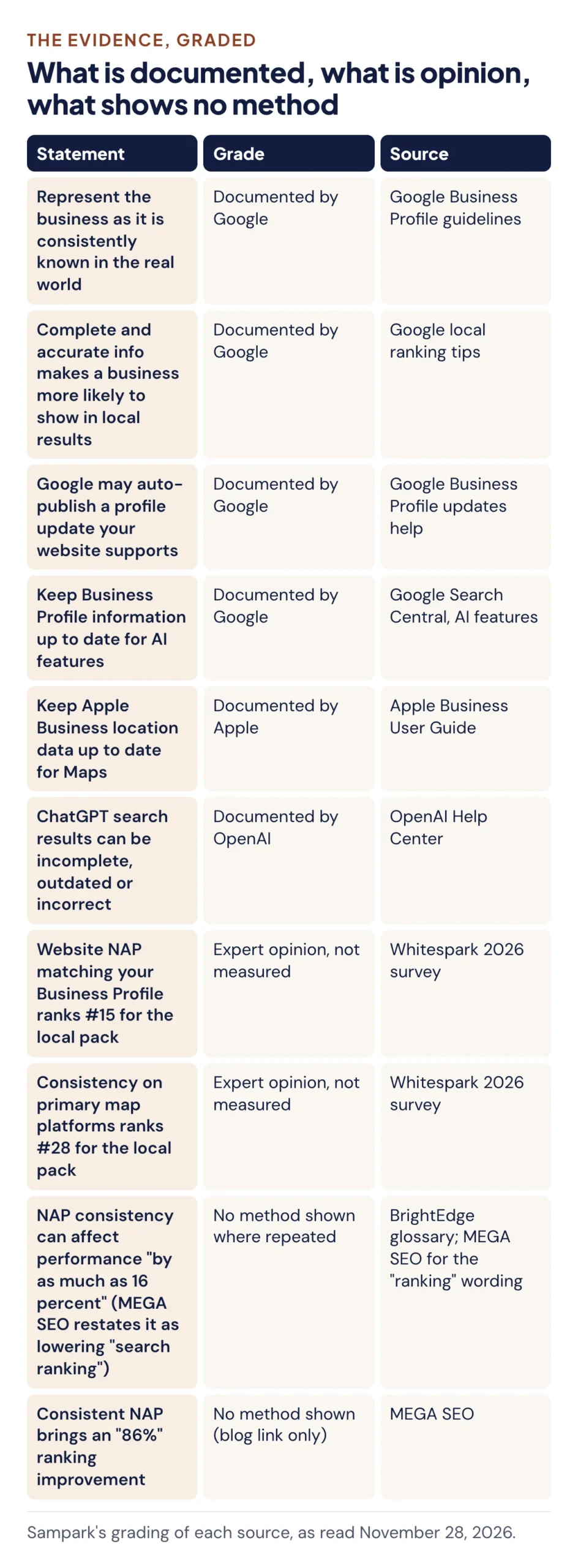
The grades are Sampark’s assessment of the sources listed, as read on November 28, 2026.
What about AI answers?
This is the newest part of the sales pitch, and the least documented.
Google’s AI features documentation says there are no additional requirements or special optimizations needed to appear in AI Overviews or AI Mode. Among its SEO best practices, it lists checking that your Business Profile information is up to date. (Our guide to what Google actually requires for AI Overviews covers that page in more detail.)
OpenAI’s help article on searching the web with ChatGPT says ChatGPT search can use location information to find local results and may share your location with trusted third-party providers for information such as nearby business listings. On iOS and Android, results may include a map. OpenAI doesn’t name its business listings provider, and we won’t guess. It also says search results and citations “can be incomplete, outdated, or incorrect.”
Apple’s guide to maintaining location accuracy in Apple Business says keeping your location data up to date helps customers discover your business on Maps. Apple may edit your place card’s name, status or hours after reviewing customer reports.
Here is what we think, labeled as inference. It is plausible that consistent business data at the sources AI tools draw on helps them treat mentions as one business. None of the first-party AI platform documentation we reviewed describes how conflicting NAP data is resolved. Nobody has shown that fixing dozens of long-tail directories changes which businesses an AI assistant recommends. If you’re wondering why an AI assistant skips your business, NAP is rarely the only reason; our piece on why ChatGPT doesn’t recommend your business walks through the others.
Where to fix inconsistencies first
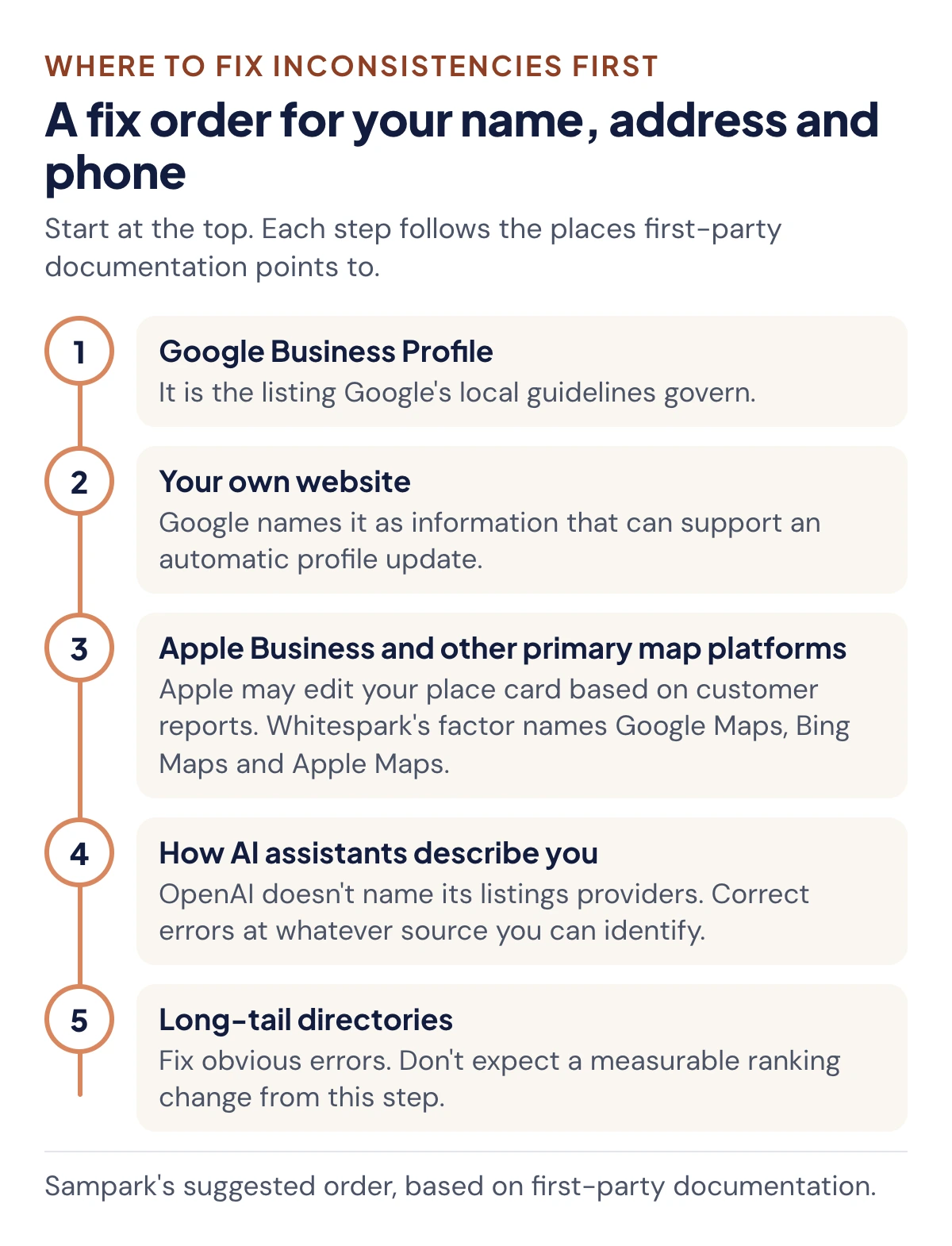
Our assessment is that fix order should follow the places first-party documentation points to.
- Google Business Profile. It is the listing Google’s local guidelines govern. Check the name against your storefront and signage, and confirm the address setting (shown or hidden for a service area) and the phone number. While you’re there, confirm your primary category too.
- Your own website. Google names it as information that can support an automatic profile update. Check the footer, contact page, location pages and any structured data, and make them match your profile.
- Apple Business and other primary map platforms. Apple documents that it may edit your place card based on customer reports. Whitespark’s factor list names Google Maps, Bing Maps and Apple Maps as the primary search engines.
- How AI assistants describe you. OpenAI says ChatGPT search may share location with trusted third-party providers for information such as nearby business listings, but it doesn’t name them. Check how ChatGPT describes your business, and correct any error at whatever source you can identify.
- Long-tail directories. Fix obvious errors when you find them, especially old phone numbers or addresses. Don’t expect a measurable ranking change from this step.
Limits: when NAP cleanup isn’t worth paying for
Google says local results depend mainly on relevance, distance and prominence. Cleanup can’t change how far you are from the searcher. It doesn’t make your services more relevant to the query, and it doesn’t add links or reviews. If your Business Profile, website and map listings already agree, a report showing dozens of “inconsistent citations” on minor directories is weak evidence that you have a ranking problem.
The case for cleanup is stronger when customers can actually be misled. A 2018 BrightLocal survey of 1,025 US consumers reported that 80% lose trust in local businesses if they see incorrect or inconsistent contact details or business names online. That survey is eight years old, vendor-run and based on what people said rather than what they did. Still, it points to the real cost of a wrong phone number: a call that never reaches you.
This article doesn’t cover call tracking numbers, multi-location brands with many listings, or Apple Business availability outside the US.
What to do next
Open your Google Business Profile, your website’s contact page and your Apple Maps place card side by side. If the name, address setting and phone number agree, most of the documented value of NAP consistency is already yours. If they don’t, fix those three before paying anyone to clean up directories.
If you’re being quoted for listings cleanup and want a second opinion on whether your listings actually disagree, Sampark’s SEO team can review it as part of a local SEO audit. We won’t promise rankings or AI mentions, and we’ll tell you if the cleanup isn’t worth it.