What is llms.txt, and does your business website need one?
llms.txt is a 2024 proposal for a Markdown file that tells AI agents what a website is and which pages matter. Google says Google Search doesn't use it, and the crawler documentation reviewed here from OpenAI, Anthropic, Perplexity and Meta doesn't say their bots read it. This explainer shows what each platform documents, as of November 27, 2026.
On this page
llms.txt is a proposed Markdown file, placed at the root of a website (yoursite.com/llms.txt), that gives AI agents a short summary of the site and a list of its most useful pages. It’s a proposal published in September 2024, not a standard that search engines have adopted. As of November 27, 2026, Google says Google Search doesn’t use it, and none of the crawler documentation reviewed here from OpenAI, Anthropic, Perplexity or Meta says their bots read it. For most business websites it’s optional and low on the list. robots.txt, not llms.txt, is the file these platforms document for controlling crawler access, though some fetchers that act on a person’s request may not follow it.
If someone has told you to “add an llms.txt for AI,” the rest of this page shows what each platform actually says, quoted from its own documentation, so you can decide for yourself.
What goes in an llms.txt file
The idea comes from the llms.txt proposal, published by Jeremy Howard on September 3, 2024, as “a proposal to standardise on using an /llms.txt file to provide information to help agents use a website.” The page was last revised in August 2026.
The proposed format is plain Markdown, in this order:
- An H1 heading with the name of the site or project. This is the only required part.
- A short summary in a blockquote.
- H2 sections, each with a list of links to important pages and a brief note on each.
- An “Optional” section for links an agent can skip if it’s short on space.
The file sits at /llms.txt, or at a subpath such as /docs/llms.txt. The proposal also suggests publishing plain Markdown (.md) versions of key pages so agents can read them without the page layout.
Here’s what that could look like for a fictional plumbing company. This is an illustrative example, not a recommendation to copy it:
# Example Plumbing Co.

> Licensed residential plumbing company serving the Dayton, Ohio area.
> Emergency repairs, water heaters and drain cleaning.

## Services

- [Water heater repair](https://example.com/water-heaters/): Tank and tankless repair and replacement
- [Drain cleaning](https://example.com/drain-cleaning/): Clogged drains and sewer line inspection

## Company

- [Service area](https://example.com/service-area/): Cities and ZIP codes we cover
- [Contact](https://example.com/contact/): Phone, hours and booking

## Optional

- [Blog](https://example.com/blog/): Maintenance tips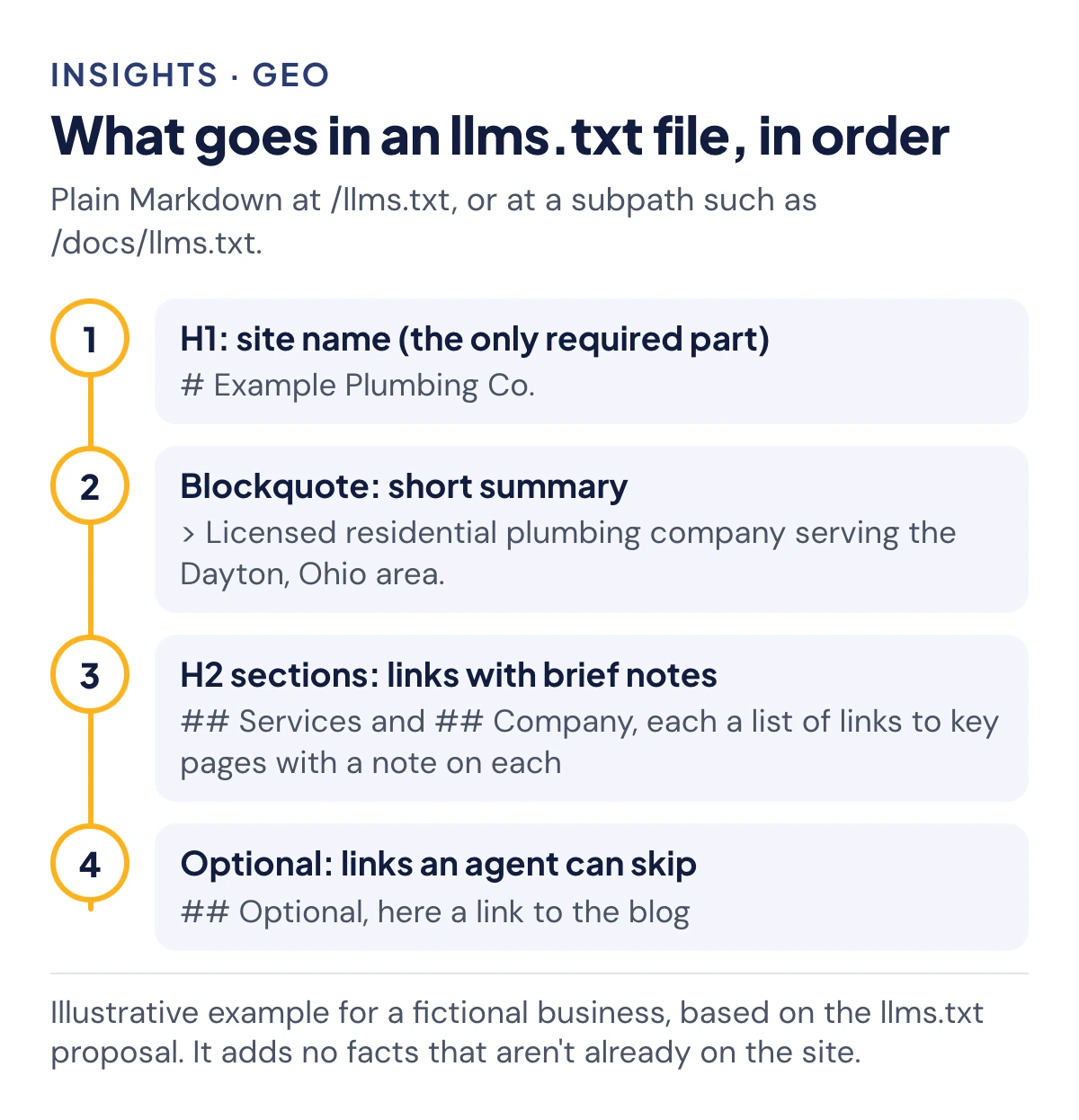
Notice what it contains: nothing that isn’t already on the site. llms.txt doesn’t add new facts about your business. It’s a table of contents aimed at software agents.
Does Google use llms.txt?
It depends on which Google product you mean, and the two answers are easy to confuse.
Google Search says no. Google’s guide to optimizing for generative AI features on Google Search lists llms.txt under a heading on what you don’t need to do. It says you “don’t need to create new machine readable files, AI text files, markup, or Markdown to appear in Google Search,” and that “Google Search itself doesn’t use them.” It adds that if you maintain llms.txt files for other services or systems, “doing so will neither harm nor help your site’s visibility or rankings in Google Search.”
Google published that guide on May 15, 2026. On June 15, 2026, its documentation changelog recorded a note clarifying that these files “aren’t needed for Google Search.” Google’s wording on this page can change, so check the live page before you quote it.
Chrome’s Lighthouse checks for one. Lighthouse, the site-auditing tool that ships in Chrome DevTools, has an llms.txt audit. Chrome’s documentation describes the file as “a machine-readable summary of a website’s content, specifically designed for LLMs and AI agents,” and says that “without this file, agents may spend more time crawling the site.” The audit flags a page if a server error occurs when fetching the file. If the file simply doesn’t exist (a 404), the result is “Not Applicable (N/A), as providing the file is optional at the moment.”
That audit sits in Lighthouse’s Agentic Browsing category, which Chrome says is “experimental and based on proposed standards.” Testing it requires Chrome 150 or later, and the category reports a fractional score. Lighthouse 13.3.0 added the category to Lighthouse’s default configuration.
These two positions don’t contradict each other. Google Search is telling you the file has no effect on rankings or appearance in Search. Lighthouse is checking whether an AI agent visiting your site would find one. Neither Lighthouse page says anything about search rankings, and a Lighthouse check isn’t evidence that any Google product reads your file.
If Lighthouse flags your site, the documented reason is a server error at /llms.txt. That’s worth fixing the same way you’d fix any broken URL: either serve a real file or let the path return a normal 404. A missing file doesn’t count against you.
What OpenAI, Anthropic, Perplexity and Meta document
This is where a lot of llms.txt advice gets muddled. Several AI companies publish an llms.txt file for their own developer documentation. That’s different from saying their crawlers read yours.
Each company’s crawler or search documentation below was read on November 27, 2026, and searched for the term “llms.” Here’s what each page says.
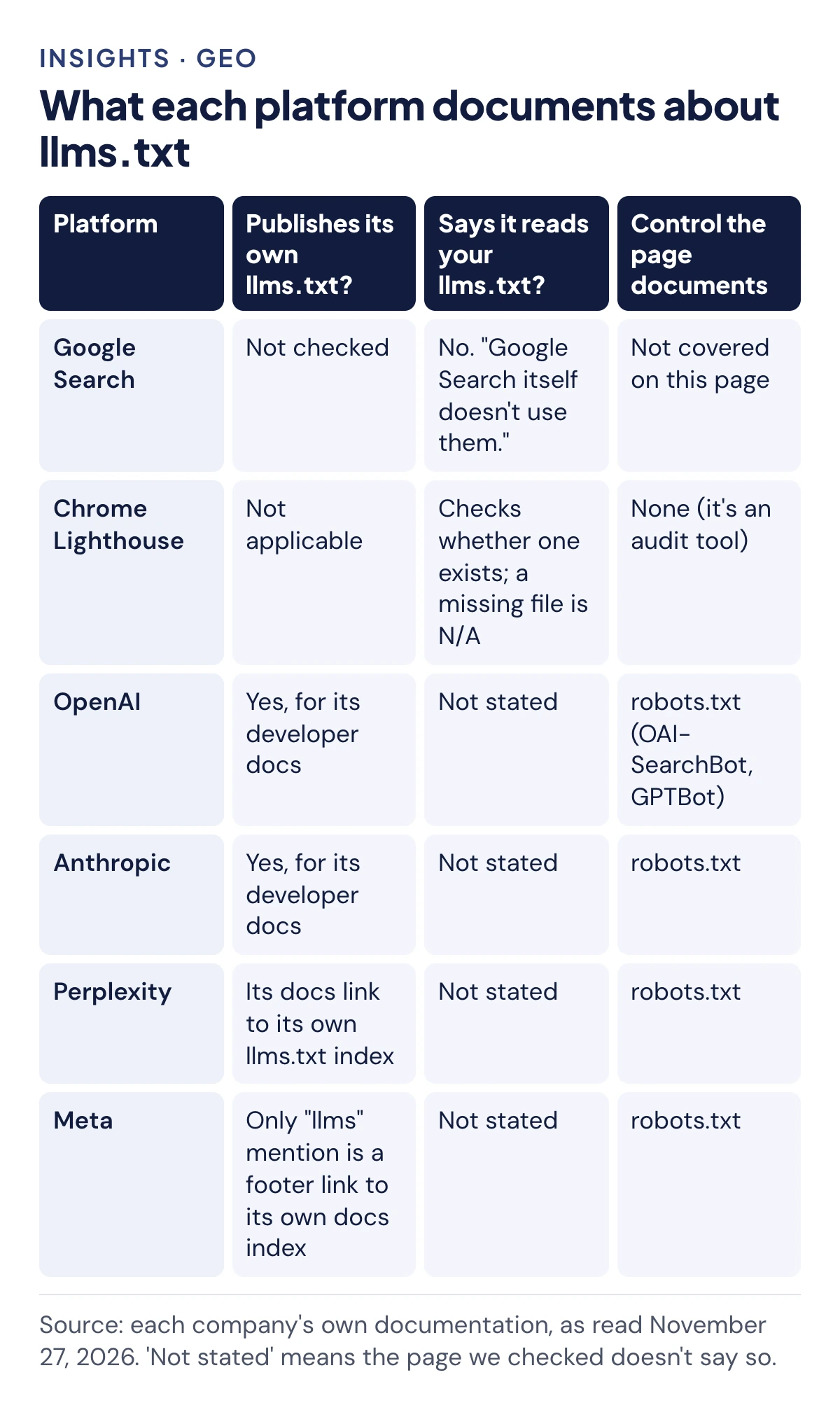
| Platform | Publishes its own llms.txt? | Says it reads your llms.txt? | Control the page documents | Page checked (Nov 27, 2026) |
|---|---|---|---|---|
| Google Search | Not checked | No. “Google Search itself doesn’t use them.” | Not covered on this page | AI optimization guide |
| Chrome Lighthouse | Not applicable | Checks whether one exists; a missing file is N/A | None (it’s an audit tool) | llms.txt audit and Agentic Browsing pages |
| OpenAI | Yes, for its developer docs | Not stated | robots.txt (OAI-SearchBot, GPTBot) | Crawler overview; ChatGPT search help |
| Anthropic | Yes, for its developer docs | Not stated | robots.txt | Crawler help article |
| Perplexity | Its docs link to its own llms.txt index | Not stated | robots.txt | Crawler documentation |
| Meta | Only “llms” mention is a footer link to its own docs index | Not stated | robots.txt | Web crawlers page |
The details behind each row:
- OpenAI. OpenAI’s crawler overview lists OAI-SearchBot, OAI-AdsBot, GPTBot and ChatGPT-User, and says OpenAI uses “OAI-SearchBot and GPTBot robots.txt tags to enable webmasters to manage how their sites and content work with AI.” The ChatGPT search help article says: “To make a website eligible for inclusion, allow OAI-Searchbot to crawl the site and confirm that the website host or content delivery network allows traffic from OpenAI’s published searchbot IP addresses.” It also says, “Placement is not guaranteed.” Neither page mentions reading a site’s llms.txt. OpenAI does publish its own llms.txt as an index of its developer documentation.
- Anthropic. Anthropic’s crawler help article lists ClaudeBot, Claude-User and Claude-SearchBot and says its bots “respect ‘do not crawl’ signals by honoring industry standard directives in robots.txt.” It doesn’t mention llms.txt. Anthropic publishes an llms.txt for its developer documentation.
- Perplexity. Perplexity’s crawler documentation covers PerplexityBot, which is “designed to surface and link websites in search results on Perplexity,” and Perplexity-User, which “generally ignores robots.txt rules” for fetches a person requests. The only “llms” mention points to Perplexity’s own documentation index.
- Meta. Meta’s web crawlers page lists its crawlers and says: “In order to block these crawlers, add a disallow for the relevant crawler to robots.txt.” It also says Meta-ExternalFetcher “may bypass robots.txt rules.” It doesn’t say any of them read a site’s llms.txt.
Our reading: as of November 27, 2026, none of the first-party crawler or search documentation reviewed here from Google Search, OpenAI, Anthropic, Perplexity or Meta says its systems use a website’s llms.txt. That’s an absence of a statement on specific pages, not proof that no system ever fetches the file. Companies can change their tools without updating their docs, and these pages change often.
llms.txt vs. robots.txt vs. sitemap.xml
These three files get lumped together, but they do different jobs.
- robots.txt tells crawlers what they may and may not fetch. Every crawler page in the table above points site owners to robots.txt as the way to allow or block their bots. If you want AI search tools to reach your site, this is the file that matters. Our guide on which AI crawlers to allow in robots.txt covers the specific bots and rules.
- llms.txt is a summary and reading list. The proposal itself says it “can complement robots.txt by providing context for allowed content.” It doesn’t grant or block access.
- sitemap.xml lists your indexable pages for search engines. The llms.txt proposal draws the line this way: sitemaps “list all pages for search engines,” while llms.txt “offers a curated overview for LLMs.” It says a sitemap isn’t a substitute for llms.txt, partly because sitemaps often won’t list LLM-readable versions of pages.
In short, llms.txt isn’t an access control. Blocking a bot in robots.txt and then listing pages in llms.txt doesn’t open anything up, and the reverse doesn’t lock anything down.
Does your business website need one?
For most US service businesses, our view is that llms.txt is a low priority. Adding one costs little, but no platform reviewed here documents any effect from it on Google Search or ChatGPT search. Time spent on it is time not spent on the things those platforms do document.
It can make more sense in a few cases:
- You publish developer documentation or an API. This is the use case the proposal was written around, and it’s the kind of content OpenAI, Anthropic and Perplexity use llms.txt for themselves.
- You expect AI agents to use your site on someone’s behalf, for example to look up product specs or policies, and you want to point them to the right pages.
- You already maintain clean Markdown versions of key pages and keeping an index is almost free.
It’s a weaker fit for a local plumber, law firm, dental practice or regional B2B supplier whose customers find them through Google and Maps. If an agency or plugin is selling llms.txt as an “AI visibility” fix, ask which platform’s documentation says it reads the file. Based on the pages reviewed here, there isn’t one yet.
If you do add one, keep it accurate. In our view, a stale file is worse than none, because it points agents to pages that are gone or services you no longer offer. Google says the file will “neither harm nor help” your Search visibility either way.
Limits of this explainer
- Every vendor position here is based on what specific pages say, checked on November 27, 2026. This page doesn’t test how any AI system behaves or analyze server logs to see which bots request /llms.txt.
- This review turned up no first-party statement about llms.txt for Google’s Gemini app, so this page doesn’t cover it.
- This page doesn’t include adoption statistics. The published figures reviewed for it came from vendor samples that couldn’t be independently checked.
- The llms.txt proposal, Google’s guidance and Lighthouse’s experimental category can all change.
What to do first
If your goal is for AI tools to find and describe your business accurately, start with what the platforms do document:
- Check crawler access in robots.txt. OpenAI says that to make a site eligible for ChatGPT search, you should allow OAI-SearchBot to crawl it and confirm that your web host or content delivery network (CDN) allows traffic from OpenAI’s published searchbot IP addresses. A robots.txt rule alone doesn’t cover the second part. Our robots.txt guide for AI crawlers walks through the main bots.
- Make sure your important pages are indexable and say clearly what you do, where and for whom. Google says you don’t need special AI text files or markup to appear in Google Search, so the pages themselves carry the weight.
- Look at how AI tools describe you today. Our guide on why ChatGPT doesn’t recommend your business sets out the usual causes and how to check each one.
- Then, if one of the cases above applies, add an llms.txt that mirrors pages you already maintain.
If you’d like a second opinion on what actually affects whether AI tools can find and describe your business, Sampark’s generative engine optimization (GEO) team can review your site. We won’t promise AI citations or rankings, because no one can.